
Forest School vs Curriculum Outdoor Learning: What’s the Difference?
If you’ve ever said “we already do outdoor learning, we’ve got Forest School”, you’re not alone! It’s one of the most common things we hear from senior leaders, and it makes complete sense. Both approaches get children outside, both are brilliant for wellbeing, and both deserve a place in primary education. But they are not the same thing, and knowing the difference could change how much value your school gets from its outdoor spaces.
So let’s clear it up.
Forest School: what it is (and what it needs)
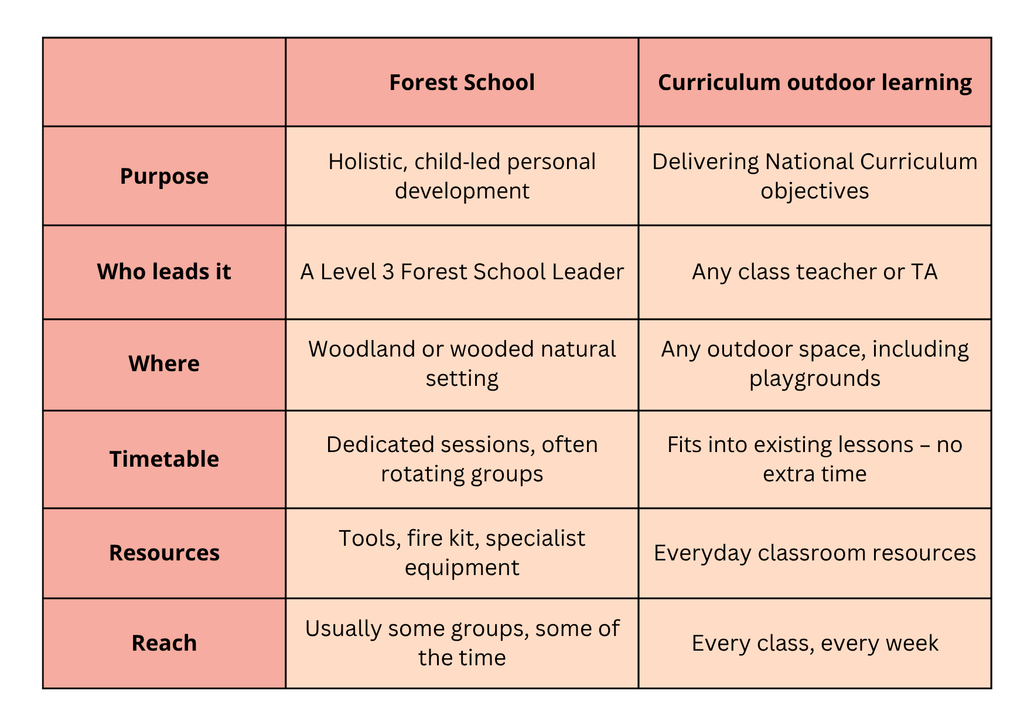
Forest School is a specialist, child-led approach. Guided by the Forest School Association’s six principles, it is a long-term programme of regular sessions in a woodland or natural setting, where children follow their own interests, take supported risks and build confidence and self-esteem through hands-on experiences.
To be true Forest School, it also needs:
- A Level 3 qualified Forest School Leader
- High adult-to-child ratios
- Access to a woodland or wooded natural environment
- Specialist activities such as tool use and fires, with the extra risk assessments and insurance that come with them
- Dedicated timetable time, often with groups rotating across a term
The outcomes can be wonderful. But because the learning is child-led, it isn’t designed to deliver specific National Curriculum objectives, and it usually depends on one or two trained members of staff.
Curriculum outdoor learning: what it is
Curriculum outdoor learning is exactly what it sounds like: your everyday lessons, taught outside. The same maths, English, science or history objectives your class is working on this week, delivered through active, hands-on, large-scale activities in your school grounds.
There’s no specialist qualification, no tools, no fire and no extra subject to squeeze into the timetable. Teachers use the expertise they already have, the spaces they already have (yes, even a playground counts and resources that are already in the classroom cupboard).
The outdoors becomes a tool for teaching and learning, not a separate activity.
The key differences at a glance
Why curriculum outdoor learning works better for primary teachers
As former primary teachers, we know the pressure on every minute of the school day. Curriculum outdoor learning works for primary schools because it doesn’t compete with the curriculum – it delivers it.
For senior leaders, that means:
- No loss of teaching time. Objectives are covered outside, so nothing is dropped to make room.
- Whole-school reach. Every teacher can do it, so every child benefits, not just the group on rotation.
- Low cost and sustainable. No specialist qualifications to fund or staff turnover to worry about.
- Measurable impact. Learning links to your curriculum, so it can be assessed and evidenced like any other lesson.
Forest School still has real value, and many schools run both happily. But if your aim is to embed outdoor learning across the school and see the impact in your core subjects, curriculum outdoor learning is the more practical route. (Worried about the weather, behaviour or workload? We tackle those in 10 Outdoor Learning Myths Holding Teachers Back.)
What the research says
The evidence for taking regular, curriculum-based lessons outdoors is encouraging:
- Natural Connections Demonstration Project (Natural England, 2016). England’s largest outdoor learning project worked with 125 schools and over 40,000 pupils to help teachers take curriculum learning outdoors. 92% of teachers said pupils were more engaged with learning outside, 85% saw a positive impact on behaviour, and over 90% of schools agreed outdoor learning was useful for curriculum delivery. Teachers benefited too: 79% reported a positive impact on their teaching practice.
- Becker et al. (2017) systematic review. Looking at regular, compulsory, curriculum-based outdoor programmes for 5–18 year olds, the researchers found tendencies towards benefits across social, academic, physical and psychological development, including improved academic performance and better transfer of knowledge to real-life situations. Eleven of the thirteen studies reported positive effects (though the authors call for more large-scale research).
- Attention and focus. Studies such as Schutte et al. (2017) found young children performed better on attention and memory tasks after time in nature. Read more in our guest post on how being outdoors supports children’s attention.
The common thread? The biggest gains come when outdoor learning is regular and embedded in the curriculum, not a one-off treat.
Where it fits with the Enrichment Framework
The DfE’s new Enrichment Framework, published in June 2026, names “nature, outdoors and adventure” as one of five categories every school’s enrichment offer should cover, with eight benchmarks to help schools plan and evaluate their provision. Ofsted will consider enrichment as part of its personal development judgement.
Importantly, the framework recognises enrichment that is linked directly to the curriculum, not just after-school clubs and trips. Curriculum outdoor learning fits neatly into several benchmarks:
- Benchmark 1 – Strategically aligned: it supports attainment, behaviour, wellbeing and curriculum priorities at the same time.
- Benchmark 5 – Accessible and engaging: every child takes part during the school day, with no cost barrier to families.
- Benchmark 6 – Works in partnership: including upskilling staff so they can lead enrichment themselves.
- Benchmark 7 – Outcomes-focused: curriculum-linked lessons are easy to evidence.
You can read the full Enrichment Benchmarks on GOV.UK.
Supporting inclusion: the Schools White Paper
The Schools White Paper, Every Child Achieving and Thriving (February 2026), puts inclusion at the heart of school improvement. Its “sidelined to included” chapter sets out a more inclusive mainstream system, with proposals for National Inclusion Standards and a requirement for schools to publish an Inclusion Strategy.
This is where curriculum outdoor learning really shines. The classes we taught were complex and full of high need, and the outdoors gave us a way to reach all children. Movement, large-scale working, collaboration, visuals and hands-on activities make the same curriculum objectives accessible to learners who struggle at a desk – without separating them from their class. It’s inclusive, quality-first teaching that happens to take place outside.
So, which is right for your school?
It doesn’t have to be either/or. Forest School offers rich, child-led experiences, and if you have it, keep it! But if you want outdoor learning that reaches every child, supports your curriculum, evidences your enrichment offer and strengthens inclusion, curriculum outdoor learning is the approach built for primary teachers.
Ready to get started?
- Explore The Alfresco Hub – 970+ grab-and-go outdoor lesson plans for Reception to Year 6, all linked to the National Curriculum.
- Book outdoor learning staff training to give your whole team the confidence to teach outside.
- Try before you commit with our free sample lesson plans.